


Showing the single result
Sound Level Meters
Noise Meters and Decibel Meters
A noise meter is a device used to measure the sound level in an environment. Such a device is often known as a decibel meter, sound level meter, or sound meter.
Read more
At TechnoKing you can choose a digital noise meter for both personal and professional use. The device can be used in a workspace, workshop, factory, office, residential environment, while various equipment is operating, and in other cases when you want to assess the noise level with a specific numerical value. The main advantage of a noise meter is that you are no longer dependent only on subjective perception. The device records the sound level and displays the result in decibels.
What is a noise meter?
A noise meter is a special electronic device that captures the sound present in an environment through a microphone and converts the obtained data into a digital value. The result is usually displayed on the screen in decibels. With human perception, it is always difficult to determine exactly how noisy an environment is. Two different devices may seem to operate with similar noise, but when measured, different values may be recorded. This is precisely why a sound level meter is used when it is necessary to obtain more objective data.
What is a decibel meter?
A decibel meter refers to a device for measuring the noise level. The term derives from the decibel, which is the unit used to express the sound level. In practice, the names decibel meter, noise meter, sound gauge, and sound meter are often used to denote the same type of device. The real difference between specific models lies in their technical capabilities. Different decibel meters may have different measurement ranges, accuracy, response speed, display, data memory function, and other parameters.
What does dB mean?
In the specifications of a noise meter, you will often see the designation dB. dB stands for decibel and is used to express the sound level. The decibel scale is not an ordinary linear scale. Therefore, even a difference of a few decibels can be practically significant. When using a noise meter, the main thing to keep in mind is that the value shown on the screen describes the sound level recorded at a specific time and a specific place. As environmental conditions change, the result may also change.
Noise level meter for the work environment
A noise level meter is especially practical in the work environment. In a production facility, workshop, construction site, or other technical space, several noise sources may be operating at the same time. This could be a power tool, machine, ventilation system, generator, engine, or other technical equipment. With a decibel meter, it is possible to compare the noise level in different work zones. Such a measurement can be useful for internal monitoring, for assessing the work environment, and for determining specifically which device or space stands out with relatively high noise. If you need the measurement for official occupational safety or compliance documentation, it is essential to follow the relevant requirements, calibration, and professional measurement rules.
Noise meter for the factory
In a production environment, noise sources often operate constantly or periodically. A noise meter for the factory allows you to compare the sound levels recorded during the operation of different machines with each other. For example, it is possible to measure the same device in different operating modes. It is also possible to compare data at different distances from the device. In this way, it is easier to see how the noise changes across the space. If regular professional monitoring is carried out at the factory, when choosing a device special attention should be paid to its technical class, accuracy, calibration capability, and compliance with specific standards.
Decibel meter for construction work
In a construction environment, a drill, rotary hammer, angle grinder, generator, and other noisy equipment may operate at the same time. A decibel meter for construction work allows you to measure the sound level at a specific location. Such data can be used to compare different work processes with each other. You can measure the same device at different distances or compare several different tools. It is important that the noise-related safety assessment in a work environment not be based solely on a single reading from one consumer device. For a professional assessment, following the appropriate methodology is necessary.
Sound level meter for the office
Noise is not important only in factories and at construction sites. In an office, too, there may be constant background noise. Its source could be an air conditioner, a ventilation system, computer equipment, sound coming from the street, or another environmental factor. With a sound level meter, you can compare the noise present in different rooms or work zones. This is especially practical when you want to identify a specific noise source or check what effect a change made to the space had.
Noise meter for the home
A noise meter for the home can be used to assess the everyday environment. For example, it is possible to measure the noise coming into a room from the street with the window open and closed. You can also compare the sound levels recorded during the operation of various household appliances. A decibel meter can also be useful during renovation, when you want to assess the noise produced by a certain tool while it operates. Such measurements allow the user to compare different conditions with specific data and not rely only on their own auditory perception.
Noise meter for checking neighbors’ noise
One of the reasons for purchasing a sound level meter can also be assessing the noise produced in a residential environment. With the device, it is possible to record the sound level present in a room at a certain time. However, it is important to distinguish between a personal measurement and an official legal or accredited measurement. The data from a consumer decibel meter may be informative for you, but for an official dispute or confirmation of compliance, a specialized measurement carried out according to the appropriate rules may be required.
Noise meter for machines and equipment
The noise produced while a technical device operates is sometimes also useful information for assessing its condition. For example, you can compare the same device in different operating modes. If after a certain time the sound level or character has changed significantly, this may become a reason for additional technical inspection. However, a decibel meter by itself cannot determine the cause of a device’s malfunction. It only measures the sound level. Therefore, the obtained data should be used together with other technical signs.
Noise meter for the car
In the case of a car, measuring the sound level can be useful for various purposes. It is possible to compare the noise present in the cabin at different speeds. You can also measure the sound level produced during the operation of the engine or another component. If certain work has been done on the car, it is also possible to compare the data obtained before and after the change. Such a measurement is informational in nature and does not replace a full technical diagnosis.
Sound meter for an audio system
A decibel meter can also be used by users interested in audio equipment. While speakers, an amplifier, or another audio system is operating, it is possible to measure the sound level at a specific location. This can be useful for comparing different settings with each other. For example, you can check how the level changes at different points in the room. If you need professional acoustic analysis, an ordinary sound level meter alone cannot provide you with all the necessary data. Such work may require more specialized equipment and software.
Decibel meter for events and music
The sound level is important for events, music venues, and various entertainment environments as well. A decibel meter allows you to check the sound level present at a specific point in real time. For example, it is possible to compare the readings obtained at different locations with each other. This can be useful for monitoring the operation of the sound system. In the case of a professional event, sound control should be carried out by an appropriate specialist and according to specific technical requirements.
Noise meter for ventilation
When a ventilation and air-conditioning system is operating, not only the airflow and temperature but also the noise may be important to the user. A noise meter for ventilation allows you to check the sound level at a specific location while the system is operating. You can compare different operating modes and find out how the noise changes when the fan speed changes. For a more thorough inspection of an HVAC system, an anemometer, which measures the parameters of air movement, can be used together with a noise meter.
How does a decibel meter work?
One of the main components of a decibel meter is the microphone. The microphone captures the changes in sound pressure present in the environment. Then the device’s electronic system processes the signal and displays the corresponding reading on the screen. The measurement result can be affected by the location of the device, the distance to the noise source, the shape of the room, and other environmental conditions. Therefore, when comparing two measurements, it is desirable that they be carried out under conditions that are as similar as possible.
How do we measure noise correctly?
When measuring noise, you should first determine what data you want to obtain. If you want to compare two devices, both measurements should be carried out in approximately the same environment and at the same distance. The microphone of the decibel meter should not be covered. It is also advisable to pay attention to other noise sources that may affect the result. For example, if you are measuring the noise of a car’s engine, another car passing nearby will change the measurement result. For more stable data, it is possible to take several measurements and compare the results with each other.
What affects noise measurement?
The reading obtained at the same noise source can change due to several factors. Distance is of great importance. As the distance from the sound source increases, the recorded level usually changes. When measuring inside a building, the walls, ceiling, floor, furniture, and other surfaces can have an influence. In an open space, however, the environmental conditions are different. Therefore, in professional measurement, not only the use of the device but also a correctly chosen measurement method is important.
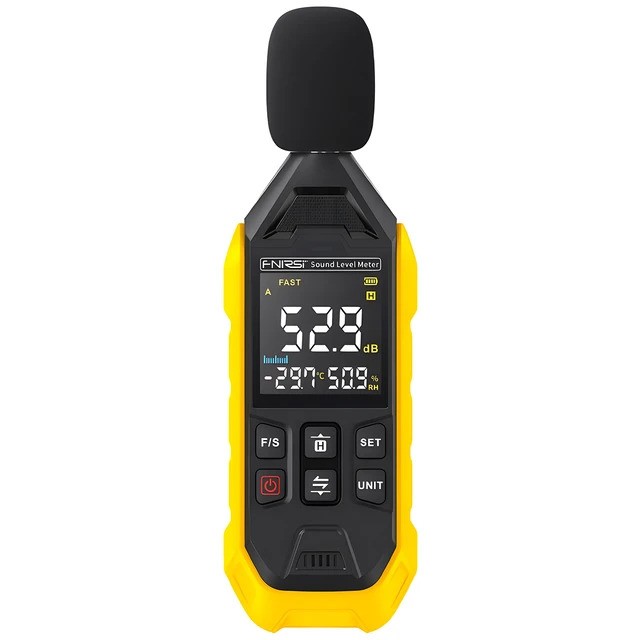
FNIRSI FDM01 noise meter
At TechnoKing, the FNIRSI FDM01 noise meter and decibel meter is available. The device’s measurement range is from 30 to 130 dB. The FNIRSI FDM01 is a digital noise level meter that can be used to quickly check the sound level in an environment. The device is of interest both to individuals and to companies that need to monitor noise readings in different spaces or with different equipment. Before taking a specific measurement, it is advisable to familiarize yourself with the device’s instructions for use and to take its working range into account.
The 30 to 130 dB measurement range
One of the main technical characteristics of a noise meter is its working range. The FNIRSI FDM01 available at TechnoKing operates in the range from 30 to 130 dB. This means that the device is intended for measuring the corresponding sound level within the specified working range. If a specific job concerns a professional or regulated field, checking only the measurement range is not enough. In addition, you should consider accuracy, relevant standards, calibration, and other requirements.
A phone app or a decibel meter?
Today there are also mobile apps that use the phone’s microphone to assess the sound level. Such an app can be convenient for a quick, approximate comparison. However, different phones have different microphones and signal-processing systems. A dedicated noise meter device, on the other hand, is designed precisely for measuring the sound level. Therefore, when you need regular or more consistent measurements, a specialized device is a more suitable choice. In the case of a need for official measurement, the device’s class, calibration, and relevant requirements should be assessed separately.
How do we choose a noise meter?
Choosing a noise meter should begin with determining the purpose of use. If you want to periodically compare noise at home, in the office, or of various devices, a portable digital decibel meter can be a practical choice. For professional use, however, more technical parameters need to be assessed. Pay attention to the measurement range, accuracy, screen readability, response modes, data storage capability, and calibration requirements. If you need to use the obtained data for an official report, you should verify in advance that the specific device complies with the required standards.
Professional noise meter
A professional noise meter can be intended for different requirements. Some users only need to see the current sound level. Others may want to record the minimum, maximum, and average values. In more specialized work, it may become necessary to record data, transfer it to a computer, apply specific frequency weighting, and calibrate. Therefore, when choosing a professional decibel meter, we should first know what type of measurement is to be carried out.
Can an official measurement be carried out with a decibel meter?
Not every noise meter is intended for official or accredited measurement. A household and general-purpose technical decibel meter can be very useful for monitoring and comparison. For an official conclusion, however, a device of the appropriate class, calibrated, and a defined measurement methodology may be essential. If you need noise measurement for a court dispute, occupational safety, an environmental requirement, or another official purpose, you should verify the appropriate procedure with a specialist.
Buying a noise meter at TechnoKing
At TechnoKing you can choose a noise meter and decibel meter for both personal and work use. The category features the FNIRSI FDM01 noise level meter, whose working range is from 30 to 130 dB. If you are looking for a noise meter, decibel meter, sound level meter, sound meter, or a decibel-measuring device, when choosing a product consider specifically where and for what purpose you intend to measure. A correctly used sound level meter allows you to compare different environments and noise sources with specific data and not base your assessment only on subjective perception.
Frequently asked questions about noise meters
What is a noise meter?
A noise meter is a device that records the sound level in an environment and displays the result in decibels.
What is a decibel meter?
A decibel meter is a device for measuring the noise or sound level. In practice, the terms decibel meter, noise meter, and sound level meter are often used to denote the same type of device.
What does dB mean?
dB stands for decibel and is used to express the sound level.
Where can a noise meter be used?
It can be used at home, in the office, in a factory, in a workshop, in a construction space, and for checking the noise of various technical devices.
Can car noise be measured with a decibel meter?
Yes. It is possible to measure the sound level in a car’s cabin or at a specific component and to compare the data obtained under different conditions.
Can a neighbor’s noise be checked with a noise meter?
For personal monitoring, it is possible to measure the sound level. However, for an official dispute, a measurement carried out with the appropriate method, a calibrated device, and by a specialist may be required.
In what range does the FNIRSI FDM01 measure noise?
The FNIRSI FDM01’s specified working range is from 30 to 130 dB.
Does a phone app replace a decibel meter?
A phone app can be useful for an approximate measurement, but phones’ microphones differ. A dedicated decibel meter is designed directly for measuring the sound level.
How do I choose a decibel meter?
Consider the purpose of use, the measurement range, accuracy, the necessary functions, and whether you need the device for personal monitoring or for professional measurements.
Can an official conclusion be prepared with a consumer noise meter?
Definitely not. For an official measurement, a device of the appropriate class and calibrated, a defined methodology, and a measurement carried out by an accredited specialist may be required.