


Showing all 3 results
Filter by price
Anemometers (Wind Meters)
Anemometers and wind speed meters
An anemometer is a measuring device used to measure air movement and wind speed. In addition to wind speed, modern digital models may also be able to measure air temperature, air flow volume and other parameters.
Read more
At TechnoKing you can choose anemometers and wind speed meters of various purposes for both professional and personal use. An anemometer may be needed for checking ventilation and air-conditioning systems, when working with heating and cooling systems, for assessing environmental conditions, in agriculture, for meteorological observation, for sports and active recreation, and in other cases where accurate data about air movement is required. When choosing the right anemometer, it is important to consider the measurement range, accuracy, units of measurement, additional functions and exactly what job you intend to use the device for.
What is an anemometer?
An anemometer is a tool for measuring wind and air speed. Its main function is to determine the speed of air movement. A digital anemometer shows the received data on the display and, depending on the model, offers the user different units of measurement. Anemometers differ in construction, sensor type, measurement range and additional capabilities. Some devices are intended only for measuring wind speed, while a more functional model can simultaneously assess air speed, temperature and air flow volume. That is exactly why, when choosing an anemometer, it is important to determine in advance whether you need only wind speed measurement or additional parameters as well.
What is a wind speed meter used for?
A wind speed meter is used in any environment where control or assessment of air movement is required. One of the most common directions is ventilation and air-conditioning systems. Measuring the speed of air coming out of a ventilation duct allows a specialist to better assess the system’s operation. An anemometer is also used to check wind speed outdoors. Such information may be of interest for meteorological observation, for agriculture, for construction, for sports activities and for other fields. In a professional environment, an anemometer is especially important when a decision should be based not on a visual or subjective assessment but on a specific measured figure.
Digital anemometer
A modern digital anemometer allows data to be obtained and read quickly. The device has a display on which the measurement result is shown in digital format. Depending on the model, the user can view wind speed in different units, for example metres per second, kilometres per hour, miles per hour or knots. This is especially convenient when different units of measurement are needed in different fields. Some digital anemometers also have a function to show current, average, minimum and maximum values. Besides a single measurement, such capabilities will help you better assess the change in air movement over a certain period.
Anemometer for ventilation
An anemometer for ventilation is one of the important measuring tools for HVAC specialists. The efficiency of a ventilation system largely depends on correct air movement. If the air flow is too low or differs significantly at different points, this may indicate the need for adjustment, cleaning or additional inspection of the system. With an anemometer it is possible to measure air speed at a ventilation outlet, in a duct or at another appropriate point. The obtained data helps a specialist assess the system’s operation. For professional work, it is advisable to choose an anemometer whose measurement range and functions match the requirements of the specific ventilation system.
Anemometer for an air-conditioning system
When assessing the operation of an air-conditioning system, air temperature alone is not always sufficient information. What matters is at what speed the air moves and how effectively it is distributed in the room. An air speed meter allows a technician to check air movement at the outlet of an air conditioner or another climate system. Such a measurement is especially interesting during system installation, diagnostics, adjustment and technical maintenance. If you need the device for HVAC work, pay attention not only to wind speed measurement but also to the ability to calculate air flow volume.
Anemometer designed for HVAC systems
HVAC combines heating, ventilation and air-conditioning systems. In this field, correctly measuring air movement is one of the important technical tasks. A professional anemometer can be used by an installation specialist, a technician or an engineer to check how air moves in the system. Comparing measurements taken at different points makes it possible to better assess air distribution. Some professional anemometers can additionally calculate air flow volume, which is an especially practical function for working with ventilation systems.
Air flow meter
Wind speed and air flow volume are related but different parameters. A wind speed meter shows at what speed the air moves at a specific point. An air flow meter, on the other hand, allows us to assess the volume of air passing through a specific area over a certain time. Such a function is especially important in ventilation systems. For example, when checking a duct or a ventilation outlet, a specialist may need to know not only the air speed but also to assess the total volume of air passing through. In this case a professional anemometer with the appropriate calculation function is needed.
Air volume meter
An air volume meter is especially useful for technical and engineering work. When designing or checking a ventilation system, it is important to know whether a sufficient amount of air moves through a specific duct or room. For this, a speed figure alone is not always enough. Calculating air volume also requires taking the relevant area into account. Some professional anemometers allow you to enter the appropriate parameters and automatically calculate the air flow volume. Such a device is especially practical for specialists engaged in ventilation installation and maintenance.
Wind speed and temperature meter
Many modern anemometers can measure air temperature in addition to wind speed. Combining two parameters in one device is especially practical when assessing environmental conditions or a ventilation system. For example, at the outlet of an air-conditioning system, both the air flow speed and its temperature may be of interest at the same time. When used outdoors, the user receives data about wind and temperature in a single device. When choosing a specific model, check both the wind speed and the temperature working range.
HoldPeak anemometers
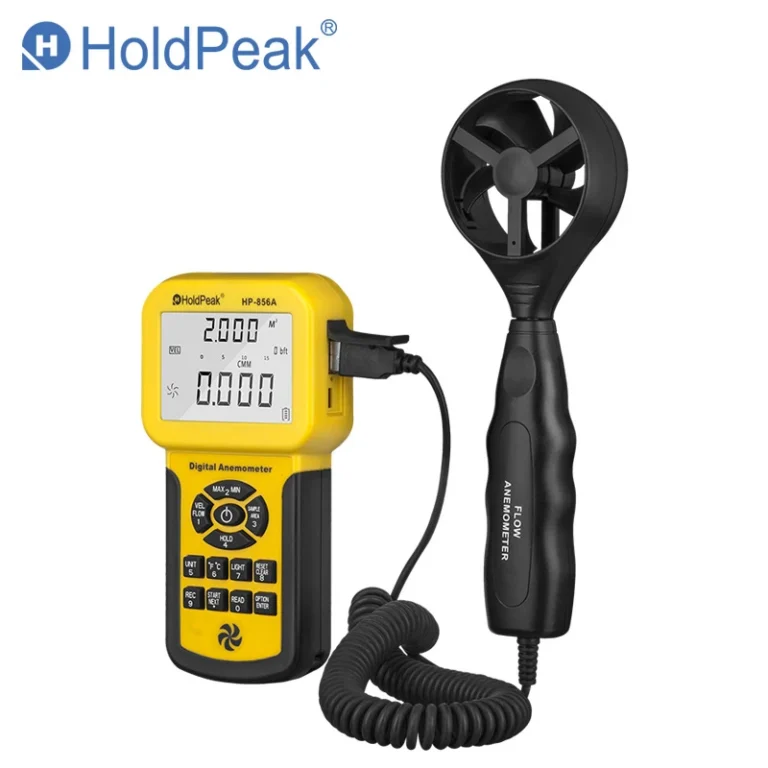
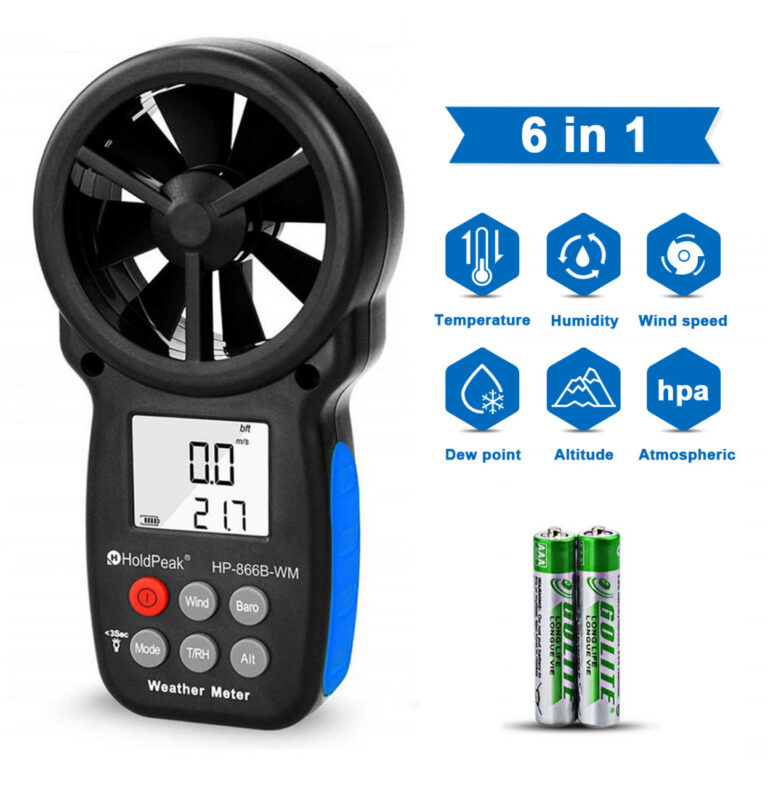
The TechnoKing category features HoldPeak anemometers, including the HoldPeak HP 856A and the HoldPeak HP 866B. The HoldPeak HP 866B is intended for measuring wind speed and air temperature. Such a device is practical both outdoors and in various technical work. The HoldPeak HP 856A is a model of interest for more professional tasks. In addition to wind speed and temperature, it can also be used for measurements related to air flow volume. Therefore, when choosing between the two models, it is important to determine whether you need only wind speed and temperature checking or whether you work with ventilation systems and need broader data about air flow.
BENETECH anemometer
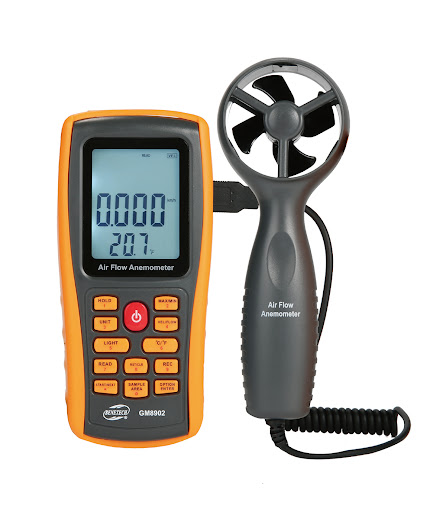
TechnoKing also offers the BENETECH GM8902 professional anemometer. The device is intended for measuring air speed, temperature and air flow volume. Such functionality is especially practical for working with ventilation and air-conditioning systems. For a professional user, measuring air flow volume is an important additional capability, because it allows a more complete assessment of the system’s operation. If you use an anemometer regularly in HVAC or other technical work, it is advisable to compare the measurement range, accuracy and additional functions of different models.
Anemometer for agriculture
Wind speed also has important practical significance in agriculture. For example, during crop spraying, strong wind can affect the direction and effectiveness of the spread of the applied product. A preliminary assessment of wind conditions may also be important when planning various field work. A portable anemometer allows you to check wind speed directly at the work site. Using a small digital device is especially convenient when you need to take measurements at different locations.
Anemometer for construction
Wind speed is an important factor during certain construction jobs and work performed at height. Assessing environmental conditions may be necessary before using equipment or when planning a certain type of work. An anemometer allows you to measure wind speed at a specific location and obtain a real figure. It is important to note that a safety decision for a specific job should not be based only on a single result from a portable anemometer. The safety rules defined for the job and the relevant professional requirements must always be observed.
Anemometer for meteorological observation
Wind speed is one of the important parameters of the weather. A portable wind meter can be used to observe environmental conditions, for experiments or to collect field data. A digital anemometer is especially convenient when you want to take quick measurements at different locations. Some models also offer the ability to show maximum and average values along with the current value. Such data will help you better assess the change in wind over a certain period.
Anemometer for sports and active recreation
Wind speed is important during activities that directly depend on weather conditions as well. This may be sailing, water sports, paragliding, drone-related activity, fishing and other activities in nature. A portable wind speed meter allows you to obtain additional information about environmental conditions on the spot. It is important to use the device’s data together with other relevant information and safety rules.
How does an anemometer work?
One of the common types is the vane anemometer. Moving air rotates the device’s vane. The sensor registers this rotation and the electronic system converts the received data into wind speed. The result is then shown on the display in the appropriate unit of measurement. For correct measurement, free movement of air near the sensor is important. If something obstructs the vane or the device is positioned in the wrong direction, the obtained result may not match the real figure. That is why, when using it, you should always follow the specific model’s manufacturer instructions.
In what units is wind speed measured?
Wind speed can be presented in different units of measurement. The most common is metres per second, which is often found in technical and meteorological use. Kilometres per hour, miles per hour, feet per minute and knots are also used. In many modern digital anemometer models, the user can choose the desired unit. This is convenient because the need for additional manual conversion is reduced. Before buying a model, check that the device supports the units of measurement used in your activity.
How to measure wind speed correctly?
When measuring wind speed, the device should be positioned so that the air flow acts freely on the sensor. When measuring outdoors, it is advisable that there be no obstacle in the immediate vicinity of the anemometer that significantly changes the natural movement of air. When measuring in a ventilation system, the result may differ depending on which point of the duct or outlet you carry out the check at. For a professional assessment, measurement at several points and comparison of the obtained data is sometimes needed. Always take into account the specific device’s usage instructions.
How to choose an anemometer?
Choosing an anemometer depends first of all on the field of use. If you need periodic wind speed measurement, a compact digital model may be entirely sufficient. If you work with ventilation and air-conditioning systems, it is advisable to choose a device that also has the ability to measure or calculate air flow volume. The measurement range is also important. The device’s working range should cover the values you plan to work with. Take into account accuracy, resolution, units of measurement, display readability and additional functions.
Professional anemometer
A professional anemometer is especially important for a user who has to measure air parameters regularly. For professional use, a wide working range, data storage, calculation of average and maximum values, connection to a computer and determination of air flow volume may be important. Not all of these functions are needed for every job. That is why, when choosing a professional model, it is advisable to determine in advance which data you use in your daily activity. If you need only wind speed and temperature, a relatively simple device can also be effective.
What is the difference between wind speed and air flow volume?
These two indicators are often confused with each other. Wind speed shows at what speed the air moves. Air flow volume, on the other hand, shows what amount of air passes through a specific area over a certain time. When assessing a ventilation system, both pieces of information are often important. That is exactly why some professional anemometers can not only measure air speed but also calculate air volume by taking the relevant area into account.
Anemometer accuracy
When selecting a measuring device, one of the most important parameters is accuracy. In the technical specifications, the manufacturer usually indicates the permissible margin of error of the specific model. For professional work, this parameter is especially important. Two devices can measure wind speed in the same range but have different accuracy. That is why, when comparing models, you should not pay attention only to the maximum measurement capability. Compare the accuracy, resolution and the working environment for which the device is intended.
Buying an anemometer at TechnoKing
At TechnoKing you can choose anemometers and wind speed meters for both personal and professional use. The category features HoldPeak and BENETECH devices, which, depending on the model, are used to measure wind speed, air temperature and air flow volume. When selecting an anemometer, review the technical characteristics of the specific product and compare the capabilities of different models. If you need the device to check ventilation, air conditioning or another professional system, pay particular attention to the ability to measure air flow volume. And if the main goal is periodic checking of wind speed in the environment, a more compact digital wind meter may also be a suitable choice. A correctly chosen anemometer, wind speed meter and air flow meter allow you to obtain the needed data quickly and base a specific job on more accurate information.
Frequently asked questions about anemometers
What is an anemometer?
An anemometer is a device used to measure the speed of wind or air movement. Depending on the model, it can additionally measure temperature and air flow volume.
What does a wind speed meter measure?
A wind speed meter registers the speed of air movement and shows the result in the appropriate unit of measurement.
Can an anemometer be used to check ventilation?
Yes. Anemometers are widely used when working with ventilation and air-conditioning systems. For professional purposes, a model that can also determine air flow volume is especially practical.
What is the difference between an anemometer and an air flow meter?
The main function of an anemometer is to measure air speed. Some more functional models additionally determine air flow volume.
In what units does an anemometer measure wind speed?
Depending on the specific model, metres per second, kilometres per hour, miles per hour, knots and other units may be used.
Can an anemometer also measure temperature?
Some digital anemometers also have a function to measure air temperature along with wind speed.
Which anemometer is good for HVAC work?
For HVAC work, it is advisable to choose a model that also offers the ability to assess air flow volume along with wind speed. The final choice depends on the requirements of the specific job and the needed measurement range.
How do I choose a wind speed meter?
Consider the measurement range, accuracy, units of measurement, the ability to measure temperature and whether you also need to determine air flow volume.
Can an anemometer be used outdoors?
Yes. Portable anemometers can be used to check wind speed in an outdoor environment, though you should always take into account the working conditions of the specific model and the manufacturer’s instructions.